


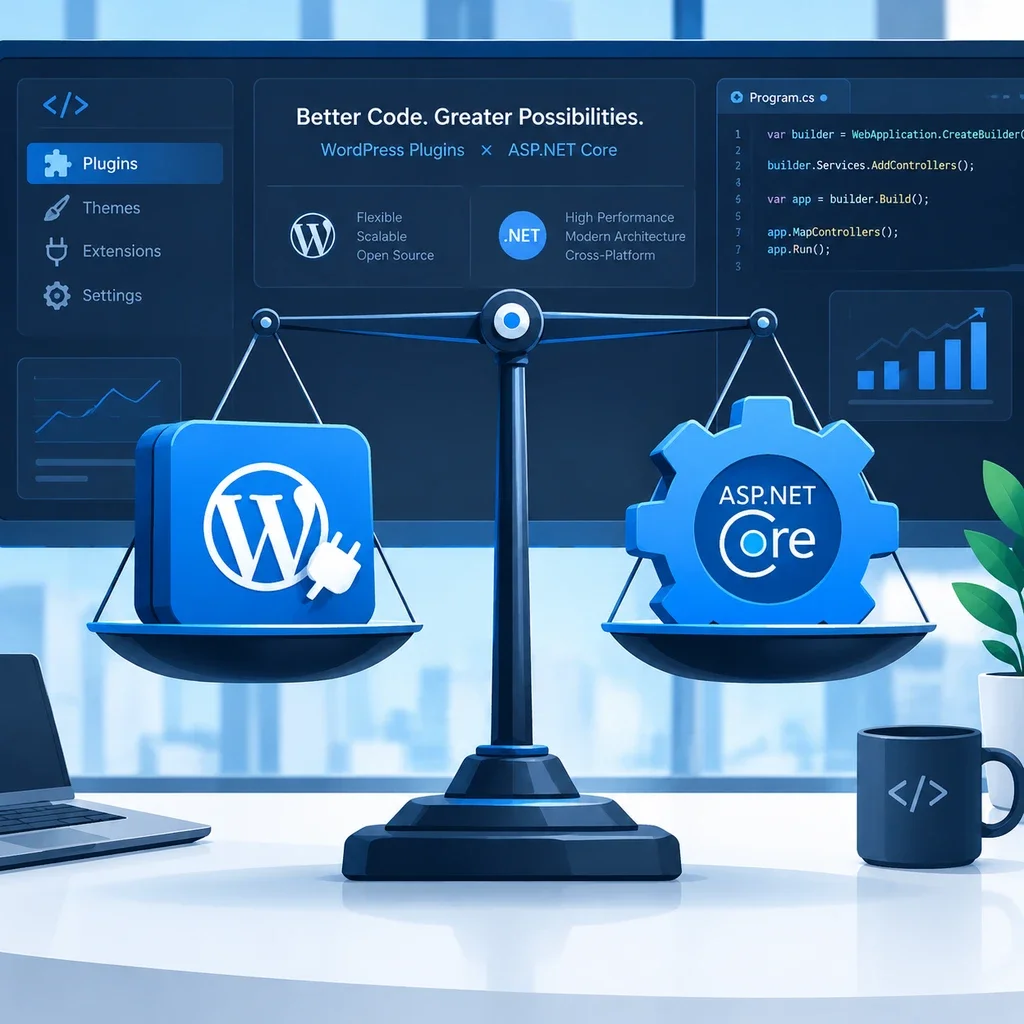
WordPress vs ASP.NET Core: Comprehensive Pros, Cons, and Selection Guide
Choosing the right platform and technical architecture for launching a website is one of the most critical strategic decisions in any online business. Many business owners find themselves torn between WordPress and ASP.NET, wondering whether they should pick a ready-made Content Management System (CMS) or invest in a powerful server-side framework like ASP.NET Core.
In this article, we compare two popular web platforms across various dimensions—including functional performance, technical architecture, security, SEO, and maintenance costs—to provide you with the clearest roadmap.

Short Introduction to Platforms: What Is the Fundamental Difference?
WordPress is an open-source Content Management System (CMS) built on PHP and MySQL/MariaDB, powering over 40% of the world’s websites. Its primary goal is rapid website deployment and easy content management without requiring deep programming knowledge.
In contrast, ASP.NET (specifically modern ASP.NET Core) is a modular, high-performance web framework created by Microsoft, developed using C#. .NET is not a CMS; rather, it is a robust foundation for building web services, large-scale enterprise portals, and software systems with layered architectures (such as Onion Architecture).
Pros and Cons of WordPress
Thanks to its massive ecosystem of plugins and themes, WordPress is the front-runner for quick deployment.
Pros of WordPress:
- Rapid Deployment with Lower Initial Cost: WordPress websites can be implemented and launched in the shortest possible time with minimal setup costs.
- Vast Variety of Plugins and Themes: Easily add payment gateways, complex forms, SMS systems, and e-commerce tools via WooCommerce without coding.
- Visual Dashboard: Any user without technical knowledge can publish articles and manage products.
- Strong Community Support: A wealth of tutorials, forums, and skilled developers are readily available.
Cons of WordPress:
- Security Vulnerabilities from Plugins: While the WordPress core is secure, installing unverified plugins, failing to update regularly, or using substandard code multiplies the hacking risk.
- Performance Lag Due to High Dependency: Loading dozens of scripts and heavy database queries on sites with numerous plugins leads to dropping Core Web Vitals and slower speeds.
- Limitations in Complex Enterprise Logic: For financial applications, banking infrastructures, or processes with custom business logic, the WordPress database structure is suboptimal.
Pros and Cons of ASP.NET (Core)
Microsoft’s framework is the top choice for companies and systems where stability, scalability, and maximum performance are non-negotiable.
Pros of ASP.NET Core:
- Exceptional Speed and Performance: ASP.NET Core consistently ranks among the fastest server-side web frameworks globally in TechEmpower benchmarks.
- Built-in Enterprise Security: Out-of-the-box protection layers against CSRF, XSS, and SQL Injection, alongside integrated identity management, minimize risk.
- Unlimited Scalability and Customization: Clean architecture, data layer separation (EF Core), and precise software design patterns enable developing massive systems with millions of transactions.
- Modular Architecture and High Testability: Supports automated unit testing and long-term maintenance without breaking other modules.
Cons of ASP.NET Core:
- Higher Development and Maintenance Costs: Requires senior software engineers, higher technical talent expenses, and specialized Windows/cloud hosting.
- Longer Initial Launch Time: Every detail, from the custom admin panel to access controls, must be coded from scratch.
- Lack of Instant Plugins: Every new feature requires analysis, coding, and testing by the technical team.
Comprehensive Comparison Table: WordPress vs. ASP.NET Core
|
Comparison Factor |
WordPress | ASP.NET Core |
|---|---|---|
| Platform Type | Content Management System (CMS) | Software Development Framework |
| Speed & Performance | Moderate (depends on hosting, caching, & plugins) | Extremely fast and optimized for high traffic |
| Default Security | Requires continuous monitoring, updates, and plugins | Very high with built-in enterprise standards |
| Technical SEO | Extremely simple with SEO tools like Rank Math or Yoast | Complete and precise control over HTML, meta tags, and schemas |
| Setup Cost | Economical and low | Higher, an investment for long-term scale |
| Time to Market | Days to a few weeks | Several months depending on software features |
| Business Customization | Limited to CMS themes and hooks | 100% freedom in architecture and database |
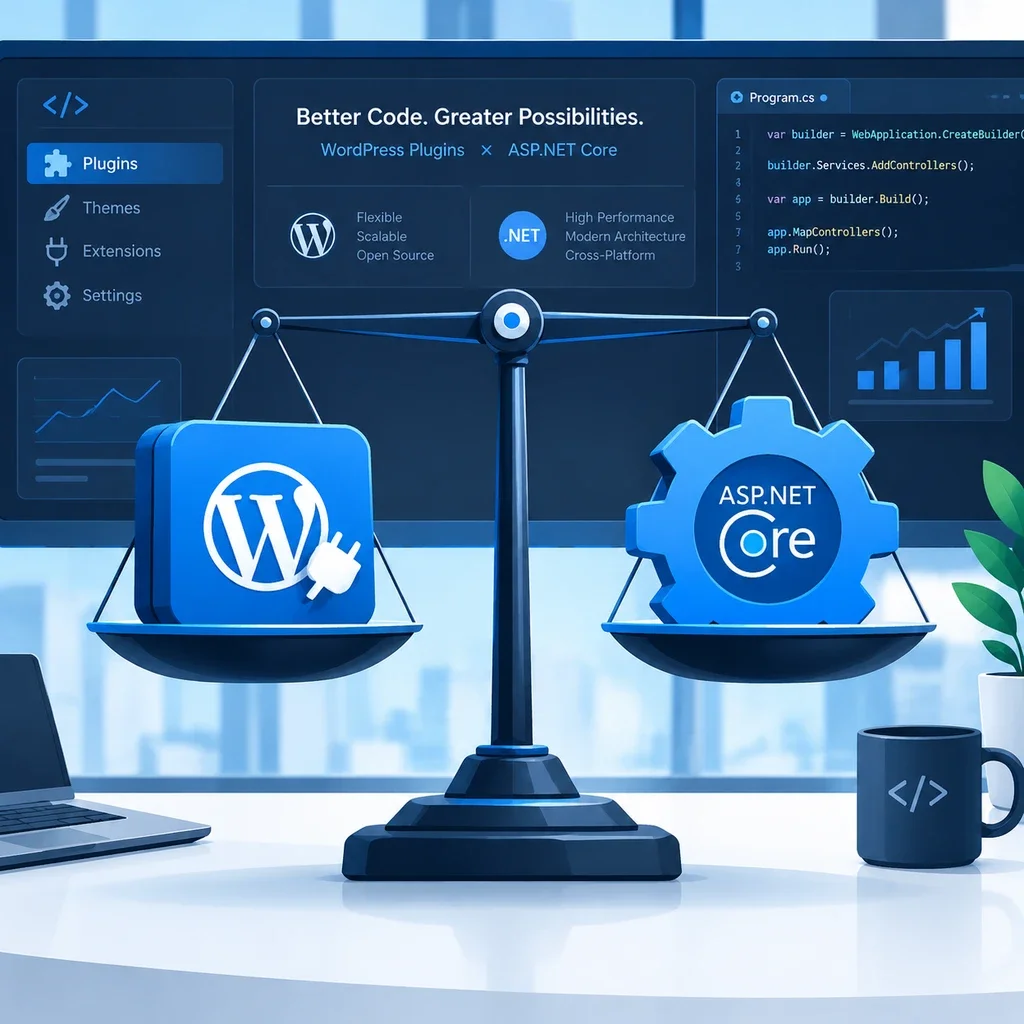
SEO Comparison: Which Platform Ranks Better?
Google and other search engines do not care about your backend programming language; what matters to search engines is the optimized frontend output (HTML/CSS/JS), page load speed (Core Web Vitals), and content accessibility.
In WordPress: Thanks to plugins like Yoast or Rank Math, managing XML sitemaps, canonical tags, metadata, standard URLs, and schema markup implementation is straightforward. An SEO specialist can control all On-Page SEO factors without touching backend code. However, WordPress’s Achilles’ heel in technical SEO is bloat: installing heavy themes and multiple plugins creates redundant JavaScript, render-blocking stylesheets, and consequently degrades LCP and INP scores in Core Web Vitals reports, requiring specialized caching and optimization knowledge to resolve.
In ASP.NET Core: There is 100% control over the final DOM output. No unnecessary files or scripts load unless defined by the software engineer. Server response time (TTFB) in .NET is typically much faster than PHP/WordPress, serving as a direct ranking signal. However, the challenge with .NET is that all technical SEO infrastructures (automatic XML sitemap generation, 301 redirects, Hreflang tags for multilingual sites, and schema rendering structures) must be properly implemented from scratch by the developer, and a lack of SEO expertise can harm site indexation.
SEO Comparison Verdict:
If your content and SEO team lacks programming knowledge and wants to quickly optimize pages without developer intervention, WordPress is a simpler and more flexible choice. But if you have a high-traffic project, dynamic pages, and a critical need for top-tier technical Core Web Vitals scores, a custom-engineered ASP.NET Core site holds the upper hand in code cleanliness and server response speed.

Comments (4)
A clear and balanced comparison. The distinction between a CMS and a development framework is especially useful for business owners.
Helpful overview. How would you evaluate the long-term maintenance cost of a custom ASP.NET Core website compared with WordPress?
The SEO section makes an important point: platform choice matters less than the quality of implementation and the rendered website.
I appreciate that the article covers both the advantages and trade-offs instead of presenting one platform as the right choice for every project.
Leave a Comment